
New regulations are reshaping the commercial vehicle industry. Both the European Regulation 2019/2144 and the USA Greenhouse Gas Emissions Standards now push manufacturers to cut fuel consumption and carbon footprint. As a result, TPMS to reduce CO2 emissions in heavy-duty vehicles has become a key compliance lever — and a smart operational investment.
What Is a Tire Pressure Monitoring System?
A direct TPMS measures the pressure and temperature of each tire in real time. It uses a wireless sensor mounted inside the wheel — on the rim, valve, or glued directly to the tire. Furthermore, it delivers absolute and accurate pressure values continuously, with no manual intervention required.
Key Benefits of TPMS for Heavy-Duty Fleets
IMPROVED FLEET & ROAD SAFETY
Over 50% of roadside breakdowns stem from tire problems[1]. Moreover, 90% of tire blow-outs and breakdowns involve under-inflated tires. Under-inflation also affects the tire contact patch, directly reducing vehicle handling, braking, and traction.
TPMS monitors pressure in real time and triggers an alert as soon as it drops below the safety threshold. Consequently, drivers can act before a breakdown — or worse — occurs.
INCREASED TIRE LIFETIME & PERFORMANCE
According to the European Tire and Rubber Manufacturers’ Association, heavy-duty vehicles run on tires that are 40% to 65% under-inflated on average. The Technology and Maintenance Council (TMC) confirms that a constant 20% under-inflation reduces tire lifetime by 30%.
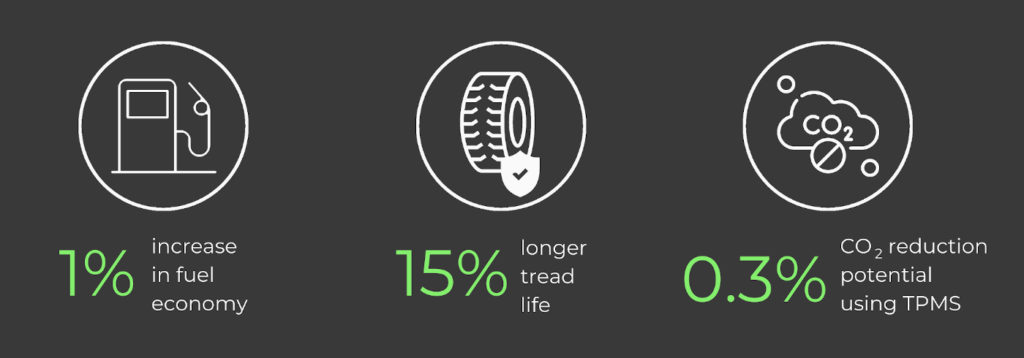
Properly inflated tires, by contrast, deliver 15% longer tread life and 20% longer casing life. Therefore, TPMS is a direct driver of tire performance and longevity.
REDUCED FUEL CONSUMPTION
Every 1 psi drop in average tire pressure increases fuel consumption by approximately 0.2%[2], according to the NHTSA. In other words, proper inflation improves fuel economy by at least 1%.
Since CO2 emissions are directly proportional to fuel use, the TNO assessment shows that widespread TPMS adoption can reduce CO2 emissions by 0.2% to 0.3% across light commercial and heavy-duty fleets[3]. For long-haul vehicles especially, the savings potential is significant.
REDUCED MAINTENANCE COSTS
TPMS and Global Regulations to Reduce CO2 Emissionsce CO2 Emissions
Medium and heavy-duty vehicles account for 23% of greenhouse gas emissions from transportation in the USA[4], and 5% in the EU[5]. Over the past decade, both regions have acted.
USA: GREENHOUSE GAS EMISSIONS AND FUEL EFFICIENCY STANDARDS FOR COMMERCIAL TRUCKS AND BUSES[6]
Phase 1 of the US Standards, implemented in 2017, cut CO2 emissions by 270 million metric tons and saved 530 million barrels of oil across model years 2014–2018. Phase 2, finalised in August 2016, covers vehicles manufactured between 2017 and 2027. Its targets include:
- Reducing CO2 emissions by 1.1 billion metric tons
- Cutting oil consumption by up to 2 billion barrels
- Saving approximately $170 billion in fuel costs
EU: CO2 Performance Standards for Heavy-Duty Vehicles[7]
The European Commission enforced Regulation 2019/2144 in August 2019. It sets progressive CO2 reduction targets for new heavy-duty trucks:
- From 2025: average CO2 emissions must be 15% lower than 2019 levels
- From 2030: the reduction target rises to 30%
According to the Commission, a vehicle bought in 2025 could save around €25,000 in fuel over five years. Furthermore, manufacturers must ensure that zero and low-emission vehicles represent at least 2% of their fleet by 2025.
A Reliable Solution for a Greener Fleet
Properly inflated tires release less CO2 by improving fuel efficiency. Using TPMS to reduce CO2 emissions in heavy-duty vehicles is therefore both a regulatory response and a sound business decision. It is accurate, reliable, and increasingly mandatory — for trucks, buses, and the fleets that depend on them.
LID Technologies is at the forefront of these developments. Learn more about our solutions.